

Fire Prevention Week 2026 runs from October 4 through October 10, but fire safety awareness remains essential all month long as National Fire Prevention Month. A useful annual prompt to do more than glance at the smoke detector and move on. A few minutes spent checking alarm placement, testing devices, and looking for electrical warning signs can uncover problems that are easy to miss during everyday routines.
This Fire Prevention Week home safety checklist is built for a practical walkthrough of a Garland home, not a complicated inspection project. Since 1996, Astar Air Conditioning, Plumbing & Electric has served homeowners throughout the Greater DFW Area, including Garland, with licensed technicians and a customer-first approach to keeping essential home systems dependable.
Start with Smoke Detector Coverage
Working smoke alarms need to be in the right places before they can do their job. Garland’s residential inspection checklist calls for at least one working smoke detector on every level of a home and one in each bedroom. For households with bedrooms grouped along a hallway, an alarm outside the sleeping area adds another layer of warning.
Walk through the home level by level, including the garage-adjacent entry area, finished attic spaces, and any converted rooms used for sleeping. Don’t assume a single device near the living room can alert someone behind a closed bedroom door, especially at night.
Check these smoke alarm basics:
- Test each alarm monthly. Press and hold the test button until the alarm sounds, then make sure everyone in the home recognizes that sound.
- Review the manufacture date. Smoke alarms have a limited service life, and the replacement date is often printed on the back of the unit.
- Replace accessible batteries promptly. A chirping alarm often signals a low battery, but it can also indicate an aging or malfunctioning device.
- Consider interconnected alarms. When one interconnected alarm detects smoke, every connected alarm sounds, giving occupants in distant rooms more time to respond.
Homes can use battery-powered, sealed-battery, or hardwired smoke detectors, or some combination. Hardwired models draw household power, usually with battery backup; battery-powered models don’t require any connection to home wiring. The right arrangement depends on the home’s layout, existing wiring, and the number of sleeping areas.
Garland homes with gas furnaces, water heaters, fireplaces, stoves, or dryers should also consider carbon monoxide detectors. Carbon monoxide is a colorless, odorless gas produced when fuel doesn’t burn completely. Garland’s inspection checklist calls for carbon monoxide detector placement within 10 feet of sleeping rooms when a property has fuel-burning appliances; an all-electric home isn’t required to have one under that checklist.
Check Detector Placement & Condition
An alarm can be fully functional and still be poorly positioned. Smoke, steam, airflow, and temperature changes all affect how quickly an alarm responds, or whether nuisance trips lead someone to disable it entirely.
Keep smoke alarms away from windows, exterior doors, supply vents, and ceiling fans where drafts can pull smoke away from the sensor. Kitchens and bathrooms need particular care because cooking vapors and shower steam can trigger false alarms. If an alarm repeatedly activates during normal cooking, don’t remove the battery or cover it. Review its location and type instead.
Photoelectric alarms are generally designed to respond more readily to smoldering fires; ionization alarms tend to respond more readily to fast-flaming fires. Combination alarms use both sensing approaches in one unit. Whatever type is installed, the device needs to be accessible for testing, mounted according to manufacturer instructions, and located where occupants can actually hear it.
Repeated false alarms, visible cracks, yellowed plastic, water damage, missing covers, persistent chirping, and devices past their listed service life all deserve attention. Cleaning dust from exterior vents can help in some cases, but never take apart an alarm or modify its internal components. If replacing one hardwired smoke detector causes other connected devices to stop communicating, or if an alarm sounds without a clear cause, call a qualified technician rather than leaving the home with reduced coverage.
Walk Through Electrical Fire Hazards
Smoke alarms provide warning, but prevention starts with the items that carry electricity every day. During this part of the checklist, look at outlets, switches, cords, power strips, and appliances where damage tends to develop gradually and quietly.
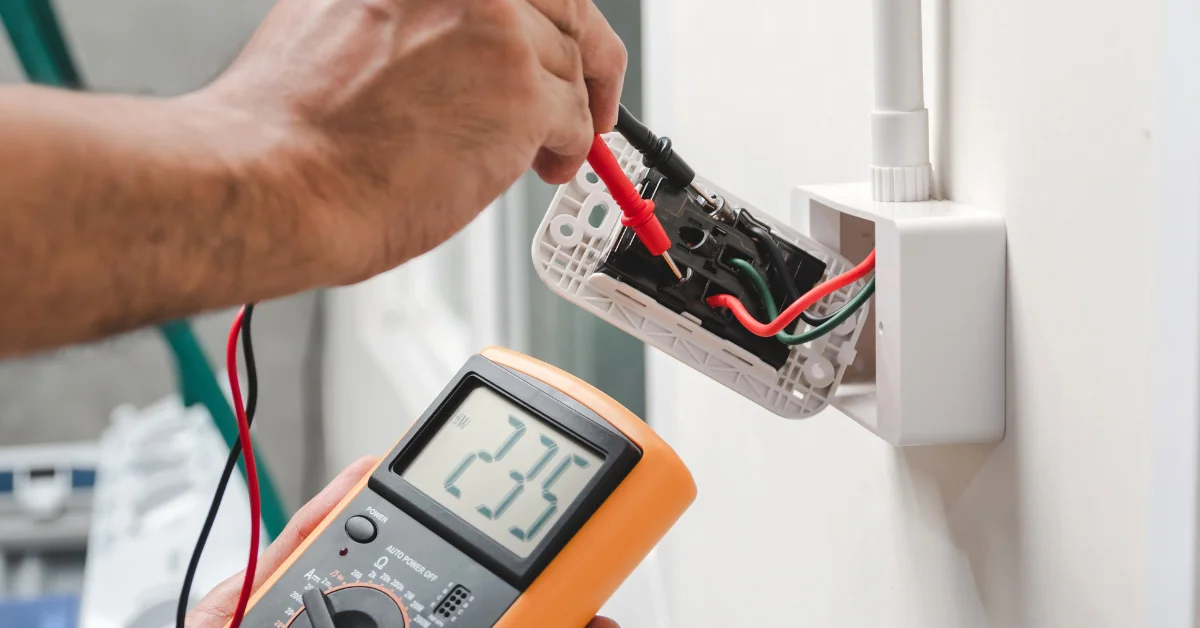
Look for outlets or switches that feel warm to the touch, plugs that hang loosely, cords with cracked insulation, and appliances that produce buzzing, crackling, or a burning odor. Flickering lights and breakers that trip repeatedly are also warning signs that deserve a real fix, not a workaround.
Electrical conditions to address promptly:
- Overloaded outlets. Avoid plugging multiple high-demand appliances into one outlet or relying on outlet extenders for permanent use.
- Daisy-chained power strips. Never plug one power strip or surge protector into another power strip or extension cord.
- Damaged extension cords. Replace cords that are frayed, pinched, hot, or routed under rugs, furniture, or doorways.
- Unsafe space heater connections. Plug a space heater directly into a wall outlet, not into a power strip or extension cord.
- Oversized lightbulbs. Use bulbs that don’t exceed the maximum wattage marked on the fixture.
Don’t reset a breaker repeatedly to keep a circuit running. A warm outlet, scorched wall plate, damaged electrical panel, or burning smell isn’t a DIY repair. Arc fault circuit interrupters are designed to detect dangerous electrical arcing, meaning electricity jumping across a gap where it shouldn’t, but their presence doesn’t make other warning signs safe to ignore.
If your Garland home needs smoke or carbon monoxide detector installation, replacement, or system evaluation, our licensed and insured technicians at Astar Air Conditioning, Plumbing & Electric are ready to help. Reach us at (972) 597-5805.
Make a Fire Escape Plan
A fire escape plan turns an alarm into action. Every person in the home should know two ways out of each sleeping area, whether that’s a door and a window or two separate doors. Make sure windows and exits can be opened quickly, and don’t block pathways with furniture, storage bins, or equipment.
Choose one outdoor meeting place a safe distance from the home. A mailbox, a neighbor’s driveway, or a clearly visible landmark across the street works well. It should be easy for children to remember and far enough away that everyone stays clear of smoke, heat, and emergency responders.
Practice the plan as a household:
- Run a drill. Practice leaving quickly so everyone knows the alarm sound, the routes, and the meeting place.
- Plan for extra assistance. Account for young children, older adults, and household members with mobility or hearing needs.
- Stay outside. Once everyone has left, call 911 from outside. Don’t go back in for pets, documents, or belongings.
Practice matters because a real emergency doesn’t leave time to decide which door is safest or where to meet. Revisit the plan after moving furniture, renovating a room, or adding a new household member.
Know When to Call a Professional
Homeowners can handle routine tasks like pressing a test button, swapping an accessible battery, and dusting off a device. Installation work, hardwired alarm replacement, wiring repairs, and recurring electrical problems require a different level of evaluation.
Professional help is appropriate when a home has gaps in detector coverage, incompatible interconnected alarms, inaccessible devices, recurring false alarms, or signs of electrical damage. It’s also worth a call if you’re not sure whether the home’s carbon monoxide detector coverage matches its fuel-burning equipment. A qualified technician can assess hardwired systems, sort out interconnected alarm issues, and help identify a detector arrangement that fits the home’s layout and sleeping areas.
Keep the Checklist in Rotation
Use this walkthrough each Fire Prevention Week, then keep the routine going with monthly alarm tests and prompt attention to any changes in outlets, cords, breakers, or appliances. A detector that chirps, an outlet that warms up, or a breaker that won’t stop tripping is far easier to address before it becomes an emergency.